
Project type
Ecommerce Website
Digital Marketing &
Social Media Project
Authors
Sharon Skillings
Lisa Gong
Tools
-WordPress
-Google Trends
-Semrush
-Google/Facebook Ads
-Google Analytics
Year
2020

Loca Yoga
Ecommerce Website

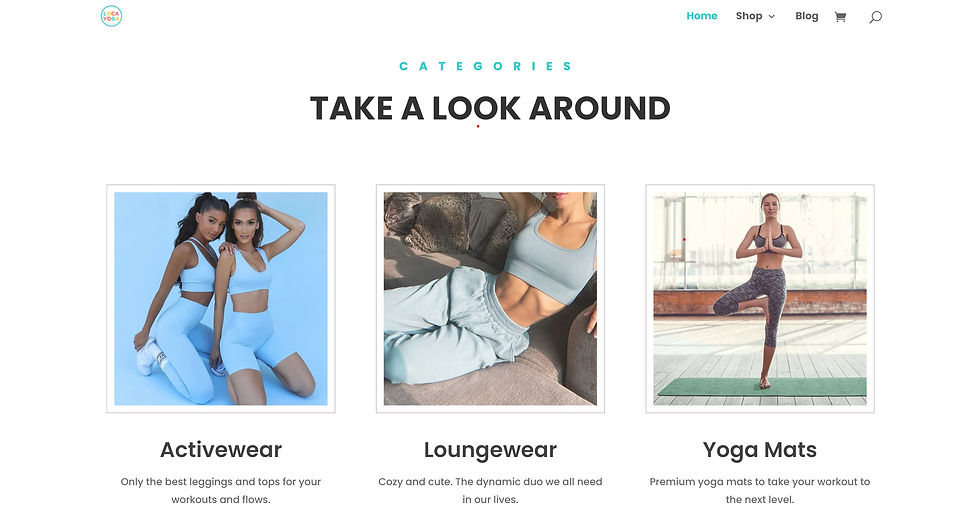
Loca Yoga was inspired by our affection for yoga and for helping others lead healthy lifestyles. Our goal was to create a space where people could discover various yoga products to enhance their yoga practice. We offer activewear, yoga mats, and other yoga accessories.
In order to determine the buying potential for yoga products we searched through consumer purchasing reports and Google Trends. This was particularly important as the year 2020 saw increased consumption of items related to dealing with quarantine and isolation during the COVID-19 pandemic.


Keyword Research
Semrush keyword
With Semrush’s Keyword Magic Tool, we found keywords to use through our website and blog posts.
To stay consistent with our store name and branding, we started researching potential keywords related to the words “crazy” and “yoga.” “Crazy yoga legging” and “crazy yoga poses” are some examples of the key words we are using throughout our website, primarily in the product pages.
We chose these keywords based on the fact that they maintain a keyword difficulty percentage under 80% and are trendy throughout the year.


We saw that health and personal care products had an influx in interest over 2020. For instance, searches for “yoga mat” far surpassed past search history around April 2020, when the COVID-19 pandemic was setting in and people began preparing home gyms.
On top of this increased interest, past search trends indicate that yoga mats are a product with steady interest at baseline. In fact, the yoga mat market grew about 7% each year from 2017 to 2021. This shows that drop shipping yoga products has the potential to yield both short-term and long-term returns since interest in purchasing yoga mats and other yoga-related products will likely remain even after the pandemic subsides.
Similarly, leggings for both working out and wearing casually saw an increase in searches and sales over 2020 (Fig. 2.2). This is why we decided to expand our store offerings from only yoga mats to include related products like leggings, sports bras, and exercise tools.
Yoga Blog
Trough WordPress blog posts, we created two articles focused on yoga practice related topics. We made sure they followed the SEO guidelines reaching scores over 90. These articles are part of our content marketing strategy, giving the audience something valuable to learn from and to enhance their yoga practice techniques. At the same time, the articles use references and links to invite the reader to our website in a more indirect way than an ad would.
-
7 useful Tips on Finding Balance and Relaxation with Yoga: This article's main keyword is “balance and relaxation.” It also uses other key words like “zen meditation music” and “yoga poses.”
-
Got Back Pain? Relieve It With These 4 Amazing Yoga Stretches: This article's main keyword is “back pain,” and it's complemented with other key words such as “yoga stretches” and “yoga moves.”


Social Media
To build a social media presence that gives validity and reliability to our business, we developed a friendly, engaging brand identity. Understanding that our target audience is young females whose most used social media apps are Instagram and Tik Tok, our posts were made natively on Instagram and directly cross-posted through the app to Facebook.
When creating content for our social media channels, we scheduled posts in a way that offered diversity and interest to our feed. We focused on two types of content:
1) real-life images of people wearing our products or practicing yoga.
2) graphic images conveying an uplifting phrase to the audience.
Facebook Ads
Over the course of 3 days we spent €8.00 on Facebook Ads, resulting in 68 link clicks and 22,803 people reached.
When creating a Facebook ad campaign, we decided to set our Campaign Objective to “Traffic” because we wanted to track how many clicks to our website the ad alone could generate. We preferred this over a product sales-focused ad, though we synced our Woocommerce catalog with Facebook just in case.
When defining the target audience for our ad, we narrowed it down to females aged 13 to 45 years old in Spain, the UK, and the US. We chose women because our clothing products are almost exclusively for women. We were also interested to see how Facebook’s ad placement algorithm would ultimately decide who to show our ads to.
The ad we designed carries on our brand personality of being lighthearted and engaging. Recognizing that our target audience prefers mobile-first social media, we ensured our ad would work well on phones.


In terms of placement per platform, while Instagram gave us a wider reach, Facebook actually yielded more results. Also of note, desktop only users largely used Facebook while mobile only users used a mix of both Facebook and Instagram.
Though, again, while greater reach of mobile only users was attained through Instagram, greater results came from Facebook. This could be because older users with more spending power use Facebook and are more likely to click ads or because the ad we designed looks quite similar to other ads that would be placed on Instagram and therefore appeared less unique and enticing to users.
Google Analytics
Over all we had a total of 74 unique visitors. After implementing our Facebook Ads, there was a clear increment on the number of visitors. Through the different data on google analytics we were able to get a few insights such as:
-It appears that the percentage of visitors is fairly equivalent between male and female users, with a slightly higher percentage skewing male. This was somewhat surprising, since most of our product offerings target female customers.
-The most common age groups to visit our website are between 18 to 24 and 25 to 34 years old. This information is helpful because it allows us to understand our audience better and find potential business opportunities, such as expanding to male product offerings
-The most frequent dates/times of website visits were on Tuesday night and early Wednesday morning. This could largely be because our Facebook ad campaign was published on a Tuesday night. Saturday night was also an active time. Understanding our customers’ activity times is helpful as it allows us to plan what days and times will be best to release ad campaigns or to engage with audiences through our social media channels.
-Geography-wise, we had visitors from all over the world, but the three locations with the most visits were:
-
Spain (27)
-
United States (24)
-
Colombia (9)
-Mobile phones seem to be the most frequent way users access the website with a percentage of 60% compared to 39% for computers and 2% for Tablets. Which means that we need to keep in mind having a good display of our website on mobile devices format to ensure a positive user experience.




Our most viewed product was the 3-ball massage roller stick. This was a bit surprising since we included it as an accessory and it is not exclusively a yoga product like most of our other items. A reason behind this popularity might be the pricing. Compared to yoga mats and sportswear, this product comes at a lower price.
Conclusions
Over all we had a total of 74 unique visitors. After implementing our Facebook Ads, there was a clear increment on the number of visitors. Through the different data on google analytics we were able to get a few insights such as:
-
Looking at the data in Google Analytics is key to planning a business as you can understand who the audience is, where they live, their age group, etc. This data can guide smart decisions when it comes to creating ads or adding products.
-
Tools such as Semrush are very useful when trying to define the keywords on your website. They help position your store higher in search results and allow you to be found by the target audience.
-
SEO is very important, and thankfully Rank Math provides a clear guide and checklist on what to look for when you are promoting your products and designing blog posts. Some of these things include: making sure the focus keyword appears multiple times in specific parts such as the title, the url, and the metadescription; Using positive sentiment and power words on the title; having more than 600 words on the product description or article, but at the same time keeping the paragraphs shorts.
-
Ad campaigns can be very powerful if done correctly. We were surprised by the massive reach that our ads had on such a low budget, but this also did not translate into many link clicks. We wanted to try Facebook’s built-in A/B testing functionality to see what changes to demographics or creative content we could make to improve click through rates. Unfortunately, this required a dedicated week of testing that we did not have.
-
A successful business is built around multiple elements, from finding a good niche, to gathering quality products with good reviews, to building a functional, appealing website, to developing an engaging social media presence, to creating an enticing ad campaign with a strong understanding of the target audience in mind. This has been such an interesting experience, we loved the chance to learn and potentially run a business.